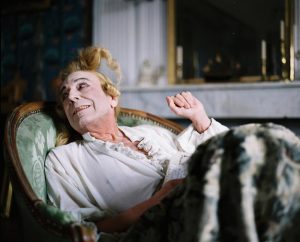
Historia de mi muerte / Història de la meva mort, Albert Serra, España-Francia, 2013 Por Roger Koza En la película más radical de Albert Serra, no menos minimalista que las más conocidas del director, la palabra tiene un lugar preponderante y novedoso, en principio porque Casanova era un hombre de letras. Casanova empieza a presentir su decadencia […]
-
CRÍTICAS BREVES (57) / MES FICUNAM 2014 (21): LA EVIDENCIA MATERIAL DE LA ABSTRACCIÓN
-
SHORT REVIEWS (17) / MES FICUNAM (20): AFTER BOYHOOD

El lugar del hijo / The Militant, Manolo Nieto, Uruguay-Argenina, 2013 Por Roger Koza At the beginning of the film, an open shot shows a deep knowledge of the (filmic) space and time occupied by the char- acters. The symbolic space is Montevideo, first, and then Salto; the character is Ariel Cruz, a young militant […]
-
SHORT REVIEWS (16) / MES FICUNAM 2014 (19): THE EVIDENT AND SECRET LIFE OF INSTITUTIONS

At Berkeley, Frederick Wiseman, EE.UU., 2013 How do institutions think? The anthropologist Mary Douglas would have loved the magnificent four-hour film At Berkeley, the 38th made by a genius, Frederick Wiseman: what we see here is the collective thought of an institution and al- though the University of California at Berkeley is undoubtedly a peculiar microcosm, […]
-
MES FICUNAM 2014 (18): LOS IMPOSIBLES

Por Roger Koza ¿A dónde van los skaters cuando llueve? ¿A dónde cuando el movimiento –cadencia y fuga– se interrumpe y los cielos… los cielos se ponen negros? Alejandro Ricagno P3nd3jo5, de Raúl Perrone, es la película argentina del año, como lo fue Tierra de los padres el año pasado y como lo será en […]
-
CRÍTICAS BREVES (56) / MES FICUNAM 2014 (17): LA MAYORÍA SILENCIOSA VIAJA EN ECONOMY

El palacio, Nicolás Pereda, México, 2013 Por Roger Koza El cine de Pereda está pasando por un período de transición. Los mejores temas fue probablemente una despedida consciente de un sistema de representación cinematográfica. Matar extraños resultó una enigmática primera prueba. El palacio es otro intento de renovación, una tentativa. Ambas películas presentan una novedad: un […]
-
SHORT REVIEWS (15) / MES FICUNAM 2014 (16): BIGGER THAN LIFE

E Agora? Lembra-me / What Now? Remind me, Joaquim Pinto, Portugal, 2013 A survivor’s confession trans- posed into cinema, a dialectic and loving treaty on theology and biology (or how Darwin, Saint Austin, and the Gospel of John can coexist in the medita- tions of a sensitive soul), a ra- diography of European politics and its decadence, […]
-
CRÍTICAS BREVES (55) / MES FICUNAM 2014 (15): PAISAJES, CUERPOS Y ROSTROS

Costa da Morte, Lois Patiño, España 2013 En la vida cotidiana, la conducta óptica rara vez imita a la panorámica del cine. Tal vez por eso, en el cine no hay muchas panorámicas como planos centrales. El plano panorámico suele emplearse para mostrar la dimensión de una batalla, dar cuenta de una locación o utilizar […]
-
SHORT REVIEWS (14) / MES FICUNAM 2014 (14): THE MATERIAL EVIDENCE OF ABSTRACTION

Three Interpretation Excercises / Trois Excercises d’ Intérpretation, Francia-Rumania, 2013 Por Roger Koza Cinema and philosophy –this thesis is not mine– create concepts. A concept gives some order to experience, and filmic shots allow seeing experience in a different way. In Three Interpretations, Puiu adapts the books Three Conversations, and A Short Tale of the […]
-
SHORT REVIEWS (13) / MES FICUNAM 2014 (12): KNOWLEDGE AND READING FOR ALL

The Joycean Society, Dora García, Belgium, 2013 By Roger Koza ‘Sculpting in time,” that was Tarkovsky’s way for describ- ing cinema. Without the meta- physical density of this Russian filmmaker, Dora García’s first feature manages to prove the meaning of that phrase within a secular context and with charm- ing lightness. Here, we literally see […]
-
CRÍTICAS BREVES (53) / MES FICUNAM 2014 (11): HISTORIAS DE ALEMANIA

El último de los injustos / Le dernier des injustes, Claude Lanzmann, Francia-Austria, 2013 Por Roger Koza A partir de un material excluido de su monumental Shoah, un film esencialmente trágico, Lanzmann vuelve sobre la primera entrevista que le hizo, en 1975 en Roma, a un personaje controversial: Benjamin Murmelstein. La naturaleza de la conversación y las características […]

Últimos Comentarios