NOUVELLE VAGUE (02)
Godard Lives, Still.
In February, Richard Linklater premiered Blue Moon, a film about Lorenz Hart, a key lyricist behind hundreds of songs that belong to the memory of classic American cinema. In May, he releases Nouvelle Vague, a period portrait tightly focused on the shooting of Breathless, by Jean-Luc Godard. Both films adhere to a very precise calendar: May 31, 1943; the summer of 1959, shortly before shooting begins, and the twenty days of filming. Why would a filmmaker choose to make, in the same year, two films about the past of twentieth-century cinema? Nostalgia? Revisionism? Definitely not. There may be personal reasons, and there always are, but they are not necessarily the ones that define the meaning of a film.
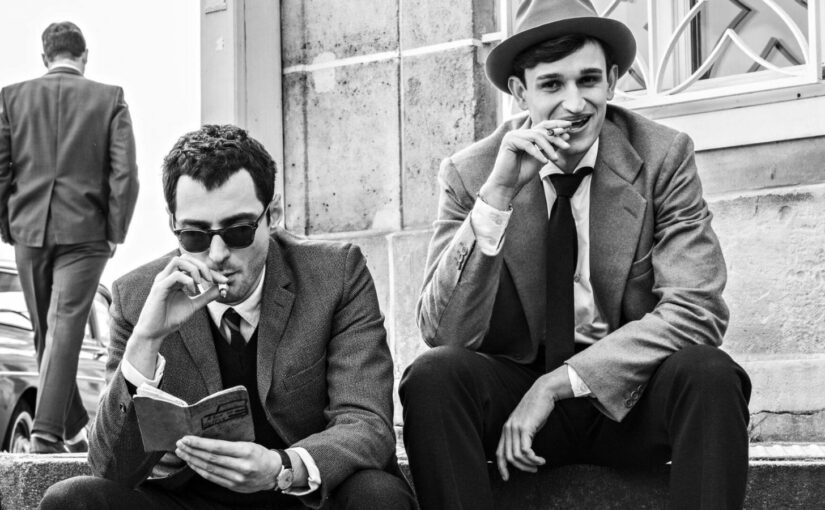
At the beginning of Nouvelle Vague, in the offices of Cahiers du Cinéma, Roberto Rossellini addresses the editors and filmmakers of late 1950s France. He says many things, but he formulates a question that he launches so that others may continue asking it—perhaps even Linklater himself: what is the urgency and the necessity for Nouvelle Vague to exist?
A first answer: it is both a timely and an untimely moment to rethink the traditions of cinema. When today’s filmmakers speak of recording rather than filming, when common discourse centers on “the audiovisual” and no longer on the shot, and when the material life of the image is commodified through the deleterious syntagm of “production value,” returning to a tradition like the one Linklater chooses establishes a relationship of tension and critique with the present. It reactivates a memory of cinema through an anomalous, foreign point of view. The past is not a museum: what has been endures as an anonymous, dispersed murmur, still alive and available for working through the present by returning to what has been in light of new problems and unpredictable needs. Simply observing the production conditions of Breathless is enough to make a contemporary filmmaker suspicious of the lessons taught in festival labs. Film what is urgent and necessary, however you can and however it may be. And film, too, with pleasure as an ally. Nouvelle Vague is pleasure in cinema as work and as a way of life.
In the meeting with Rossellini, there is one notable absence: André Bazin (to whom Linklater devoted an extraordinary passage in Waking Life). He had already died. Nearly everyone else is there. Most of the celebrated names of the era appear, alongside others less read today. The casting is remarkable. Those who play Rivette, Rohmer, Truffaut, Chabrol, Resnais, Bresson, Melville, and so many others who appear briefly seem to share some genetic trace with those they invoke. The resemblances are gifts of chance. There is something beautiful in the intermittent appearance of those who forged cinephilia in its purest form. When they enter the frame, one feels like celebrating, as if seeing them meant they were alive again. Rivette steps into the scene and his name is immediately inscribed in the shot. The citation becomes a source of joy, a celebration. The game of resemblance serves a second purpose: it desacralizes. It was necessary to attempt to dispel genuflection and obedience. With this method of presentation, the path is lightened. There was no other way to film people who, in some cases, have attained the rank of deities. Nouvelle Vague is the film of a believer, but not of a kneeler. They are simply men and women; there are no idols here, only comrades with cameras, who made cinema freer in their time—and, why not, in ours as well. Once again, one more time: what is the urgency and the necessity for Nouvelle Vague to exist?
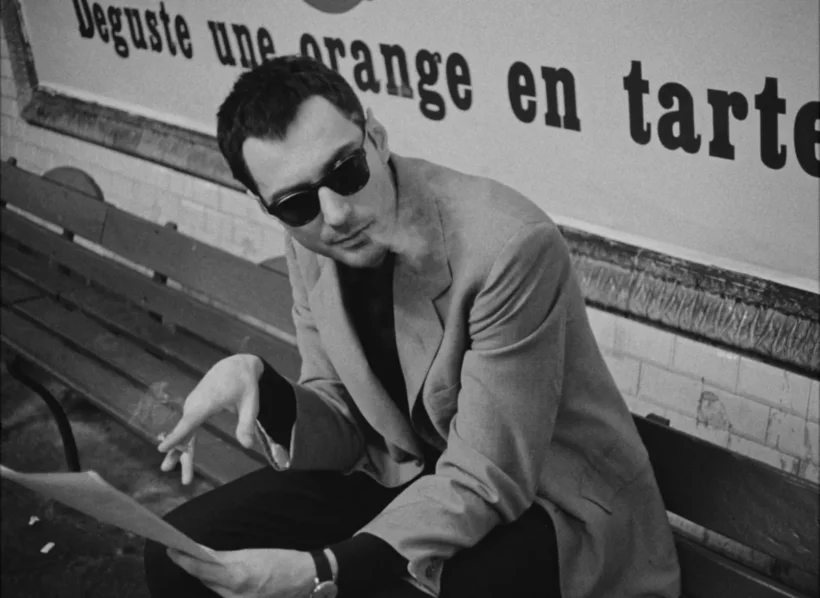
The actor who plays Godard is a fascinating discovery. The resemblance is obvious, but what Guillaume Marbeck brings to the character is not the result of mimicking the myth, but of an imaginative recreation of a young man with a purpose and a vision. Marbeck’s Godard has the vitality of his age and the conscious ambition of someone who has glimpsed something for cinema and must make it in order to prove his lucidity. Many of the things the character says can be found in interviews from the period. Godard’s thoughts are transformed into statements that emerge organically from the dialogues, neutralizing the sermon. Some of the filmmaker’s better-known phrases are used with elegance, cited without abusing the repertoire. Like Godard, Linklater has always been interested in the word in cinema, and in Nouvelle Vaguethis interest is demonstrated through the very praxis of a shoot, where what is said directly affects what is filmed. Conversation is constant, before and after “action” and “cut.”
In 1960, Godard declared: “Mise en scène is like modern philosophy—say Husserl, Merleau-Ponty. There aren’t words on one side and thought on the other. Thought first and then words. Language is not something in itself, not a simple translation. The same is true of mise en scène. When I say mise en scène is not a language, I mean that it is at the same time thought. It is life and reflection on life. That’s why in my films I make my characters talk about everything. I capture them in life itself.” This is precisely what becomes palpable in Linklater’s film, but the achievement is that his film is a compendium of moments from the shoot, not of Breathless itself. In this sense, what Linklater manages to film is how Godard “captured them in life itself,” restoring the reverse shot of the shoot as a symmetrical mirror in which the filmmaker also “captures” Godard, Jean-Paul Belmondo, and Jean Seberg in front of and behind the camera, within an indistinguishable flow between filming and living.
There is a glorious moment where the indistinction between cinema and life reveals itself with clarity comic and paradoxical, shot or reverse shot, documentary or fiction: Belmondo runs toward nowhere down the street, about to collapse from a gunshot to the back. He is about to die. Breathless follows the character from behind; Linklater chooses the opposite point of view, allowing us to hear Belmondo calmly reassuring passersby: nothing is wrong, they are shooting a scene. This is one luminous moment among others. Linklater includes the filming of most of the scenes that would later become iconic and takes the opportunity to add something else, to test another way of observing how Godard’s first feature was made. In what feels like a last-minute bonus, we also glimpse the beginning of the editing process—the filmmaker’s greatest pleasure.
The twenty days of shooting leave us with a corollary. Godard’s decision to dispense with a script carried a sense of disobedience in that context. What meaning does that gesture have today? Could a filmmaker like him exist now, at that age, capable of disregarding the imperatives of production and the requirements of professionalized cinema? Was he able to film that way because he had seen so many films, read everything, and written about movies as a kind of conceptual gymnasium? Yesterday’s and today’s conditions are different, but the possibility of repeating Godard’s dissident gesture under other coordinates is as suggestive as it is necessary.
What will the French say about this Godard by Linklater? The Austin filmmaker has never been a Francophile in any superficial sense, beyond choosing Paris as the setting for Before Sunset and, of course, being deeply familiar with French cinephilia. Linklater was formed by watching Welles, Godard, and Kiarostami. To encounter Godard, to revive him in his imagination, he chose a cast without stars and shot in French. He dispensed with color, emulating the light of Godard’s own film. He preferred to omit jealousy, disputes, and other conflicts typical of the time. He did not deny the reality of the period, but chose to prioritize the legend of a shoot. Linklater’s Godard is generous, moderately narcissistic, self assured. He enjoys humor, leans toward play, and believes in friendship. This last quality is what shines and grows throughout the film and later—happily—in the imagination of the blessed spectator. It may have been as Linklater imagined it, but this is where the American filmmaker’s worldview colors everything. What happens among the people involved in the shoot as the days go by is what often happens in many of Linklater’s films. There are echoes of Dazed and Confused and The Newton Boys in Nouvelle Vague: an affective bond allows them to do things they could not do alone. From uncertainty and mistrust, an intelligent affective current is established; it resolves differences and amplifies individual virtues. This faith—an object of mockery and contempt in the spirit of our time—that every human being is a possible friend in the present or the future becomes evident in the relationship between Coutard and Godard. Work happens, and affection finds its consecration. According to Linklater, it was a shooting touched by grace. Perhaps he is right. Beginning to believe is the first step.
Roger Koza / Copyleft 2025

Últimos Comentarios