
BERLINALE 2026 (10): THE WAY THINGS ARE
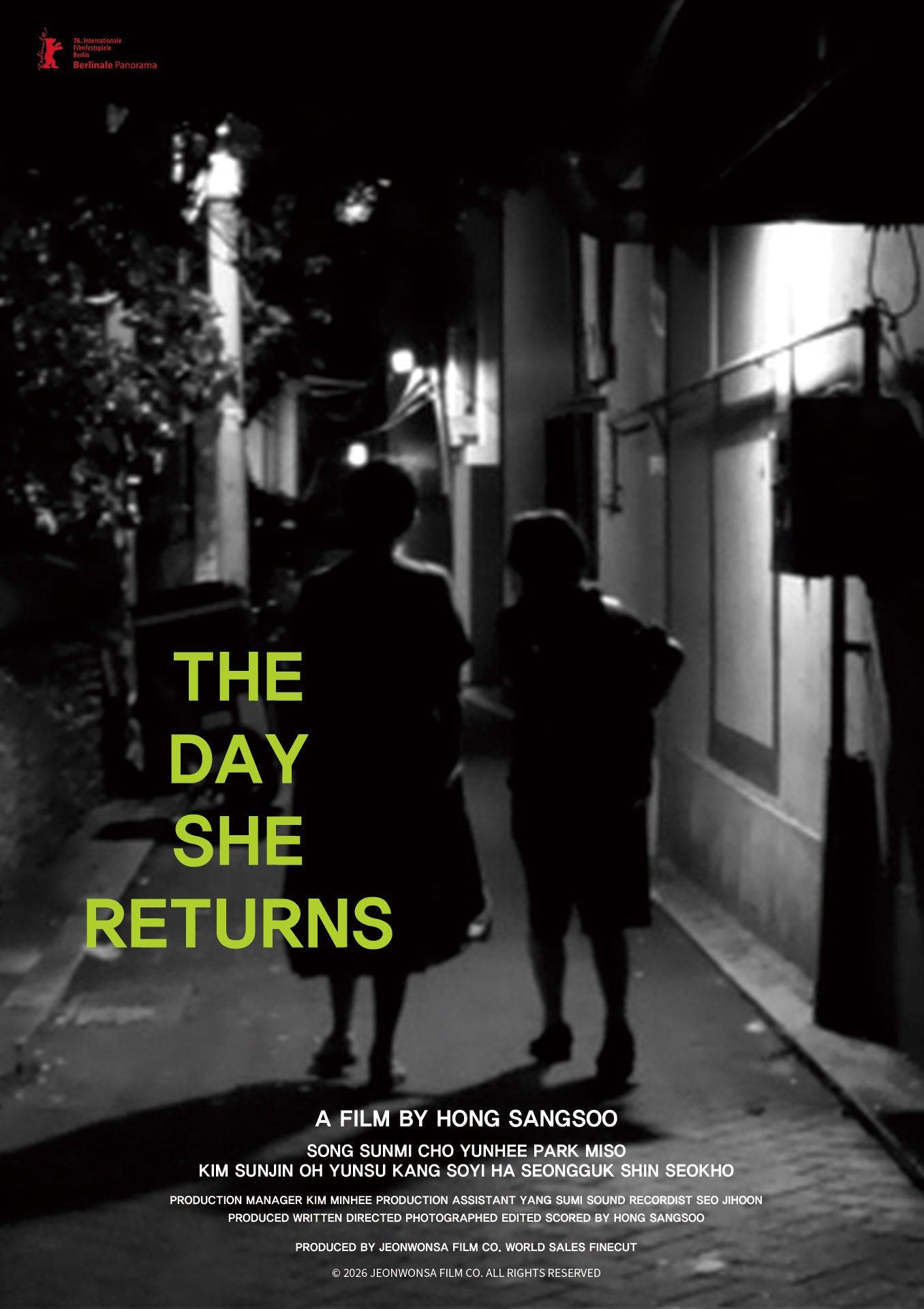
Airfare and accommodation for Hong Sang-soo and his leading actress, Song Seon-mi, must have cost more than the final budget of his latest film, premiered at the Berlin International Film Festival. If they travelled first class from Seoul to Berlin, two return tickets would be around €9,000. With another €2,000 for hotels and meals, their stay in Germany nearly matches the cost of his films.
If the filmmaker’s works cost $15,000, as he has repeatedly stated, it is a curiosity worth noting. Indeed, one could devise a Berlinale ranking of the most austere films in the programme: Nicolás Pereda, with Lo demás es ruido, and Hong, with Geunyeoga doraon nal (The Day She Returned), would be hard to beat. It is only fair to add the small marvel by Pascal Bodet, entitled Beaucoup parler. Worthless on the stock exchange, in the waning universe of festivals they embody what is missing.
Let us return to the numbers. Hong’s roles in his film are sevenfold: he directed, wrote, produced, composed the score, conceived the sound design, edited, and handled the cinematography. Seven times Hong. Song, present in every scene, is accompanied by five female characters; one visible male; and another who is only heard, remaining perpetually off-screen. There are twenty shots, each of irregular duration. The third, lasting around ten minutes, must be among the longest in all of Hong’s films. Number of zooms: fewer than ten—perhaps even fewer—and predominantly zooms outwards, immediately reframing and fixing the distance of the recording in relation to the characters, composing a not entirely orthodox medium shot. The elementary guitar chords recur five times and do not strictly correspond to the chapter divisions, which are indicated numerically and number only four.
Everything that occurs is confined to three interviews conducted by three film critics—all women, all young—with a well-known actress who has just divorced and is returning to filmmaking after twelve years, partly at the request of her young daughter. In truth, there is a fourth interview, but it repeats the first, with manifest textual variations: a performance staged in a theatre class. The teacher tends to work with material drawn from the students’ lives. From lived experience, they are asked to write a scene and immediately perform it. The interview spaces are enclosed, and the transition from one to another always includes a brief scene in which the actress smokes both an electronic cigarette and conventional ones in the small square opposite the interview bar.
What more can be said? After three consecutive colour films, The Day She Returned is, from beginning to end, in black and white. As in the last decade of Hong’s cinema, female characters predominate, and not everything is confined to attempts at romantic or affective understanding between men and women.
The filmmaker’s concern with language is nothing new. In Hong, a character often ventures a sui generishypothesis about the function of language and experience. To describe and to be described constitute acts of power and, at the same time, of clarification. This interest can be traced back to his earliest films and has intensified over the past ten years, coinciding with the replacement of male leads by women. The celebrated actress who returns, Bae Jeongsu, reiterates in the interviews the implications of language for conscious life.
It is in the first interview that the actress’s amateur existential epistemology is most clearly articulated. She remarks in passing that the endlessness of interpretations causes her anguish; she feels that everyone’s perspective on everything is infinite, a ceaseless linguistic activity that ends too late—only when one ceases to exist. Her desire is to elude the incessant murmur of collective hermeneutics in order to contemplate things as they truly are. This vision concerns the world, but also consciousness itself. What lies before or after interpretation presupposes a direct relation between what is and what can be said about what is. In that concordance lies a hope of serenity. At one point she speaks of a day when that transparency between herself and what is—which seems the province of mystics and analytic philosophers alike—came upon her for a few minutes. Her conjectures ebb and flow, counterpointed by other remarks that may concern German beer, the qualities of a script, the conflicts inherent in divorce, or the benevolent nature of dogs. The absolute lightness with which a theory of language is sketched is a salient sign of Hong’s genius. Is Hong a Taoist or a Buddhist? At moments one recalls the traditions of Zen Buddhism, as well as Taoism and intermittent fasting; these are not innocent references, yet they carry no greater weight than other words. At times, Bae Jeongsu seems to channel the Indian sage Jiddu Krishnamurti. His lucidity consisted precisely in believing that it is indeed possible to see things as they are, from which an ethics was derived—the end of conflict—and an aesthetics of existence—a state of plenitude. Is such an experience of clarity between consciousness and all it perceives possible? It is not for Hong to answer.
In Hong, conversation is neither subject to nor oriented towards the progression of a story seeking its climax and a symbolic reward in its resolution. The originality lies in disregarding any telos, without neglecting the implication that a word uttered in the tenth minute may have when repeated forty minutes later and used a third time in the epilogue. To disseminate a concept throughout scenes does not mean binding the set of statements, questions, and answers into a conclusion articulated as the omega point of the plot, because Hong’s films do not even respond, in themselves, to a notion of plot.
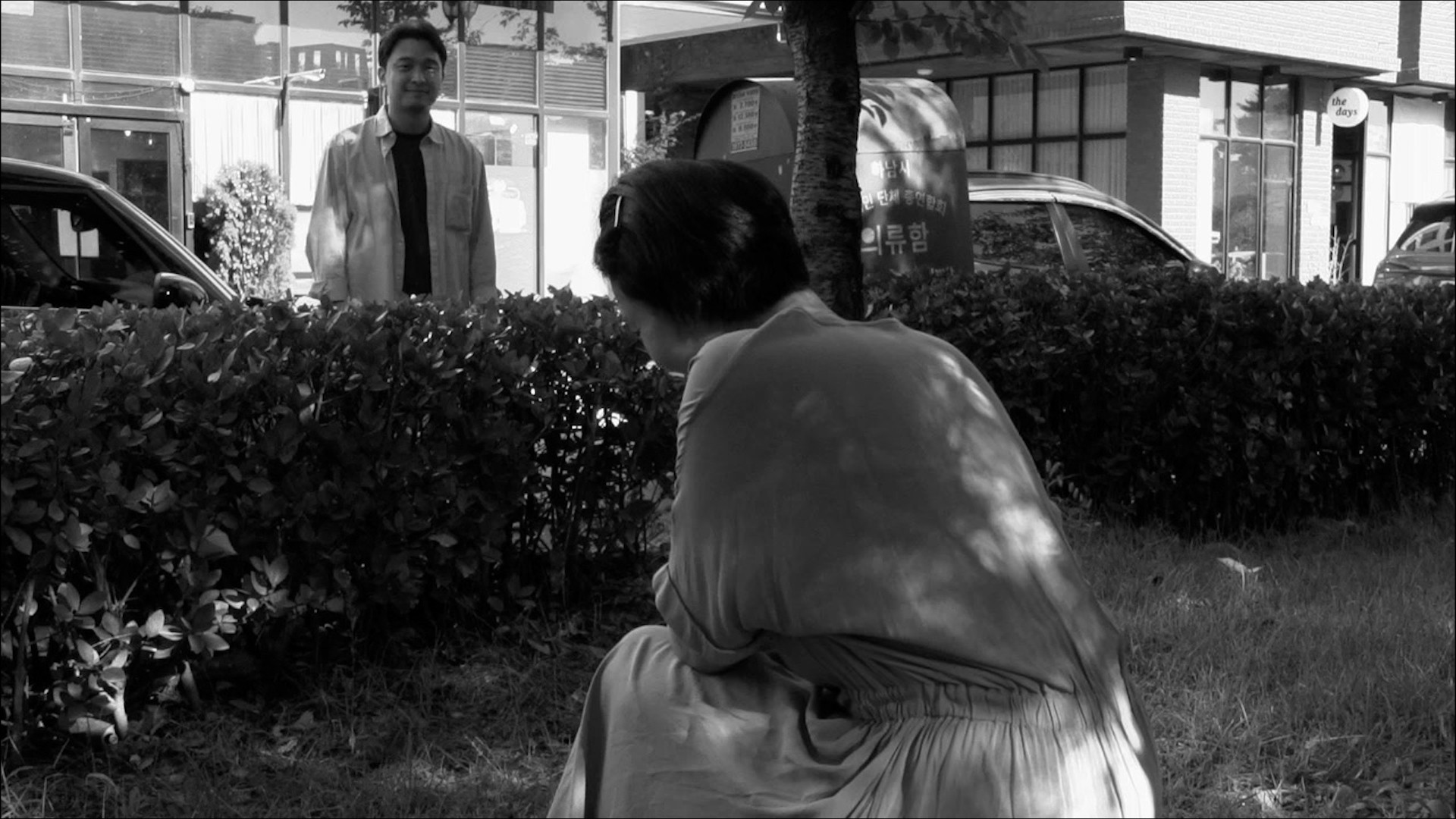
This is why the dialogues display their own fluidity and local self-sufficiency, as if each scene could be separated from the rest, screened in isolation, and yet retain the vitality of that fragment as though it were an entire film. What comes before and after maintains a relation of causality, but not one of necessity. In the four interviews in The Day She Returned, the idea that the best a person can do is to love or care for themselves is expressed repeatedly and acquires markedly different nuances through repetition. It is an example of the mode of dissemination characteristic of conversations in Hong’s films.
In this sense, there does exist a network of signs that organises itself coherently within the speculative adventure Hong places in the mouths of his characters. In this, the Korean filmmaker is not far removed from the structure of any Platonic dialogue, albeit without the dialogic stratagems of one who already knows the conclusion. The syllogism belongs to philosophers; curiosity about beliefs—which are nothing but habits of action—proves fertile in cinema, perhaps because belief can be observed in action.
Words are a primary resource for the filmmaker, as is the so-called language of cinema. It is unusual for Hong not to attempt something different; his poetics are fully consolidated, yet not closed. It is evident that this poetics is tied to a model of frugal production. Variation is a poetic principle, and in The Day She Returned one finds small deviations from what has already been explored.
There are two zooms out that begin on an object—a glass, for instance—and, in the movement, the camera shifts rapidly to the right; it then seeks the centre and reframes at a distance similar to that of the compositions already explored in preceding scenes. In the third shot of the film, one of the longest, the zoom in corresponds to a shift in the intensity of the conversation. It is not a strict rule in Hong, but one may observe that this adjustment of focus functions as a form of punctuation.
There is something in the initial texture of the image that recalls what is perhaps Hong’s finest film, The Novelist’s Film, yet the few changes of setting do not result in an appreciation of variations in light gradation. The final interview, which is in fact a repetition of the first with textual differences—since it is a reconstruction within a theatre class—sheds light on the actress’s relation to what she says and also on Hong’s own self-awareness regarding the lack of sharpness in his images. What reason has there been in recent years for his refusal to participate in the regime of visual clarity?
The Day She Returned might well have been in the official competition. It premiered in Panorama. During the Q&A, the Korean filmmaker, aged 65, said that neither fame nor money mattered to him. He said it without petulance, almost under his breath, yet without innocence. It is worth stating, because ostentation is not confined to business, cars, and the city’s luxuries. The greatest ostentation is that which is inscribed upon the white screen. There are films that can show nothing but the cost of their making.
Roger Koza / Copyleft 2026


Últimos Comentarios